leave a message
If you are interested in our products and want to know more details,please leave a message here,we will reply you as soon as we can.



Imagine a sudden storm knocks out your power. Your refrigerator of food, your phone, and critical medical devices all depend on backup energy. Choosing the wrong portable power station could leave you powerless or even damage your electronics. That is why selecting the right unit matters so much. The global market for portable power stations is now valued at USD 1.85 billion in 2024, showing how many people rely on them. But you must choose wisely. A typical lithium-ion battery lasts 500–1,000 charges, while a LiFePO4 version can exceed 3,000 cycles. This lifespan difference is critical. A smart choice protects your investment and keeps your devices running safely when you need them most. Modern Lithium Portable Power Stations offer this reliable solution for everyday emergencies and outdoor adventures.
Choosing the right portable power station protects your devices and keeps them running during emergencies.
Match the station's wattage and capacity to your needs to avoid frustration and damage.
A LiFePO4 battery lasts over 3,000 cycles, saving you money and providing long-term reliability.
Calculate your power needs in watt-hours to pick the perfect size for your adventures.
Invest in a quality portable power station for safety, convenience, and peace of mind.
You plug in your mini-fridge, and nothing happens. The compressor tries to start, then clicks off. This frustration is common when a portable power station cannot handle the startup surge of your appliance. A typical household refrigerator draws 100–250W while running. Its startup surge is generally 2 to 3 times that running wattage. For a portable refrigerator with similar compressor characteristics, the startup surge required to start it typically falls in the range of roughly 200W to 750W. If your station's continuous output cannot meet this demand, your devices simply will not run.
This problem goes beyond inconvenience. A station that lacks sufficient continuous output may power small electronics but fail on larger loads. You might find yourself unable to run a heater, a blender, or a CPAP machine during an emergency. The result is a device that sits unused when you need it most.
Under-powering your devices creates real hazards. Voltage sag causes devices to reboot, flicker, stop charging, or draw more current. Laptops and chargers on unstable power risk overheating, failed charging, adapter wear, or sudden shutdowns. Brownouts can cause electronics to crash, freeze, and lose data. These issues shorten the lifespan of expensive equipment.
Safety is another concern. Using a station not designed for certain devices can create a fire hazard. A portable power station that cannot deliver stable power may overheat internally. This risk increases when you push a unit beyond its rated capacity. Choosing a portable power station with adequate capacity and a quality Lithium Iron Phosphate Battery Pack protects your gear and your home.
A correctly sized station delivers steady power without interruption. Your mini-fridge starts on the first try. Your laptop charges without flickering. The key is matching the unit's output to your devices' demands. A [right size portable power station] handles both startup surges and continuous loads smoothly. Modern Lithium Portable Power Stations use advanced battery management systems for this consistent performance. You can enjoy your camping trip or ride out a storm without power worries.
The correct [capacity] also matches your lifestyle. A 500Wh [portable power station] keeps your phone, tablet, and lights running for a weekend trip. A 1500Wh unit powers a mini-fridge and medical devices during extended outages. You pick the size that meets your needs. This fit prevents frustration. You never face a dead battery when you need power most.
Buying the correct [portable power station] once saves money over time. A unit that is too small forces you to upgrade later. That wasted expense adds up quickly. The table below compares costs between a [portable power station] and a gas generator:
|
Cost Factor |
Portable Power Station |
Gas Generator |
|---|---|---|
|
Upfront cost |
Higher initial price |
Lower upfront cost |
|
Fuel costs |
None — no fuel required |
Fuel expenses add up |
|
Maintenance costs |
Very little upkeep |
Regular oil changes, fuel stabilization |
|
Long-term value for occasional use |
Better value for occasional backup |
Justifies cost only for continuous high output |
A [portable power station] needs no gasoline or oil changes. You charge it and store it. Ongoing costs remain nearly zero. A gas generator requires fuel purchases and regular servicing. For occasional camping or emergencies, a [portable power station] delivers better long-term value. [Portable power stations] also run silently without exhaust fumes.
[choosing a portable power station] means gaining peace of mind too. Your devices operate safely without noise or pollution. The [right size portable power station] fits in your car or closet with ease. For robust performance, an Emergency Backup Power Station 1000W provides reliable backup. A Lithium Iron Phosphate Battery Pack lasts over 3,000 cycles, giving you years of dependable service. When you [choose a portable power station] wisely, you invest in convenience and safety. This is [choosing the best portable power station]: matching [capacity], features, and battery chemistry to your needs.

Answering this question starts with understanding two different electrical terms. Watts tell you whether a device will run. Watt hours tell you how long it will run. You need both numbers to choose the right size portable power station.
Think of running wattage like a car's cruising speed on the highway. The engine maintains that speed comfortably for hours. Startup surge is like acceleration from a stoplight. It demands a brief burst of extra power. A portable power station works the same way. Its continuous output must exceed your device's running wattage. Its surge capacity must handle the momentary spike when motors, compressors, or pumps start.
A label reading "200W / 400W peak" means the normal AC output limit is 200 watts. The station provides only limited short-term headroom for startup behavior. Do not use peak watts as your planned running load. Always plan around the continuous output rating.
This distinction matters for motor-driven appliances. A typical circular saw needs a minimum inverter rating of 2,500 to 3,000 watts to handle its motor's starting surge. The surge rating should be at least 200% higher than the saw's rated power. For a 15A, 1200W corded circular saw, the surge requirement reaches approximately 2400 to 3000 watts. A portable power station that meets only the running watts will shut off when the saw starts.
The energy formula is simple: watt hours equal watts multiplied by hours. Multiply your device's power by the hours you use it each day. This gives you the battery capacity in watt-hours you need.
A general portable power station size guide breaks capacity into three ranges. Small electronics like phones, laptops, and lights need 100 to 500Wh. Camping and essential devices need 500 to 1,500Wh. Demanding applications like refrigerators and power tools need 1,500 to 3,000Wh.
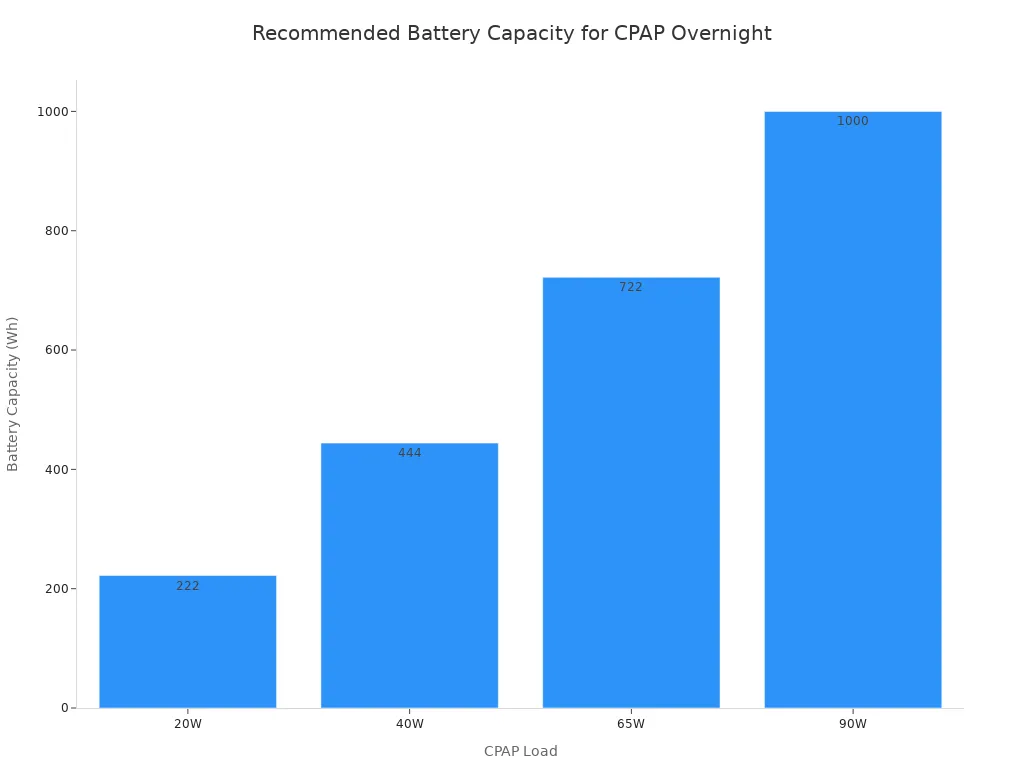
Consider a CPAP machine. The table below shows recommended battery capacity needed for different loads:
|
Average CPAP Load |
8-Hour Energy Use |
Minimum Battery (90% efficiency) |
With 25% Reserve |
Recommended Capacity Class |
|---|---|---|---|---|
|
20W |
160Wh |
~178Wh |
~222Wh |
250Wh+ (if usage confirmed) |
|
40W |
320Wh |
~356Wh |
~444Wh |
500–600Wh |
|
65W |
520Wh |
~578Wh |
~722Wh |
700Wh+ (1,000Wh-class for stronger reserve) |
|
90W |
720Wh |
~800Wh |
~1,000Wh |
1,000Wh+ |
A 500Wh portable power station can power a 60W laptop for approximately 7.5 hours under normal active use. A 596Wh battery extends that to about 8.9 hours. For camping, a 12V compressor fridge consumes 240 to 600 watt hours per day depending on size. A 45-watt compressor fridge running 8 hours daily uses approximately 360 watt hours.
List every device you plan to power. Check the wattage label on each one. Multiply running watts by expected hours. Add a 25% safety buffer. This total reveals your portable power station capacity requirement. A quality Lithium Iron Phosphate Battery Pack delivers over 3,000 cycles, making your investment last for years.

You now know your portable power station size. The next step involves battery chemistry and output features. These considerations when choosing a portable power station guide your purchase.
You compare different portable power stations. LFP batteries, also called lithium iron phosphate, weigh more per watt hours than NMC cells. A typical LFP cell delivers 90–160 watt hours per kilogram. NMC cells reach 150–250 watt hours per kilogram. This means lithium iron phosphate packs weigh more for the same watt hours.
|
Battery Type |
Energy Density Range (Wh/kg) |
|---|---|
|
LiFePO4 (LFP) |
90–160 |
|
NMC |
150–250 |
Why choose LFP then? Lifepo4 lasts over 3,000 cycles. Standard lithium-ion lasts only 500–1,000 cycles. Lifepo4 chemistry handles high temperatures safely. LFP resists thermal runaway. Your portable power station with lifepo4 cells stays safe for years. Lifepo4 delivers consistent watt hours across thousands of cycles. A lifepo4 battery offers safety advantages. Lifepo4 technology continues to improve. The lifepo4 formulation provides stable chemistry for long life.
Lithium iron phosphate is the longevity leader. LFP chemistry gives you decade-long reliability. Lithium iron phosphate batteries serve you best for cycle life. The power station battery chemistry you select determines replacement frequency. LFP cells require no maintenance. Lifepo4 requires no upkeep. The capacity of your LFP station matches your needs exactly.
Your portable power station connects to devices through multiple ports. Modern portable power stations include AC outlets, USB-A ports, and USB-C ports with Power Delivery. USB-C delivers 60 to 100 watt hours per charge. That speed charges a laptop fast. USB-A delivers 10 to 18 watt hours for phones.
|
Port Type |
Charging Speed Range |
Notes |
|---|---|---|
|
USB-C (PD) |
30–100 watt hours |
Supports laptops, drones, tablets |
|
USB-A (QC) |
10–18 watt hours |
For phones, headsets, action cams |
Recharging speed depends on your input source. Wall outlets recharge fastest. Solar panels work off-grid. Car adapters function during travel. Your battery capacity determines how many watt hours you store. A larger capacity requires more recharge time.
Understanding watt hours helps you plan energy use. You match battery capacity to daily needs. The total watt-hours your station holds dictates runtime. The size of your portable power station affects how easily you carry it. A 500 watt-hours capacity suits weekend trips. Higher watt-hours readings mean longer runtime.
For a robust solution, start with reliable Lithium Portable Power Stations that combine lifepo4 cells with fast charging. A quality Lithium Iron Phosphate Battery Pack stores many watt hours. An Emergency Backup Power Station 1000W provides reliable backup with LFP longevity.
Lithium iron phosphate batteries deliver over 3,000 cycles. Lifepo4 chemistry requires no upkeep. LFP offers consistent performance across decades. Lithium iron phosphate cells serve you for years. Lithium iron phosphate batteries are the longest-lasting option for dependable energy.
The right portable power station is a personal decision. You must understand your power needs and the station's specifications. Matching wattage, capacity, and features to your lifestyle invests in safety, convenience, and reliability. Use the general portable power station size guide above to decide with confidence. For a robust solution, explore a high-quality Emergency Backup Power Station 1000W or a durable Lithium Iron Phosphate Battery Pack. Lithium iron phosphate lasts over 3,000 cycles. Lithium iron phosphate batteries resist thermal runaway. Choose lithium iron phosphate for long-term value. A well-matched portable power station serves you for years. Compare portable power stations carefully before you buy.
Modern Lithium Portable Power Stations combine advanced battery technology with smart management systems. These answers help you select the right unit.
Running watts sustain normal operation. Surge watts handle startup spikes from motors. Your portable power station must exceed both. An lfp portable power station handles these loads well. Asking what size portable power station do i need begins with understanding these two ratings.
List each device and its running watts. Multiply by usage hours. Add a 25% buffer. That total is your battery capacity in watt hours. A portable power station with lfp cells stores energy efficiently.
Yes. lifepo4, also called lfp, lasts over 3,000 cycles. lfp resists thermal runaway. lfp handles high temperatures. lfp requires no maintenance. This portable power station chemistry is ideal for emergencies. An Emergency Backup Power Station 1000W uses this durable chemistry.
Yes. Most portable power stations accept solar input. Match the panel voltage to your station's input range. Solar speed depends on panel wattage. A portable power station with proper capacity handles solar well. An lfp portable power station recharges efficiently.
lfp cells provide over 3,000 cycles. Used weekly, that equals a decade. This makes a portable power station a smart investment. Choose lfp for long life. Understanding what size portable power station do i need helps you pick right. A durable Lithium Iron Phosphate Battery Pack delivers consistent performance.
leave a message
Scan to Wechat :

Scan to WhatsApp :